What is rkuSOL, and how does it work on Jupiter Lend?
rkuSOL is Raiku's liquid staking token, backed by SOL delegated to validators running Raiku's client and issued via Sanctum. Since 4 November 2026, rkuSOL can be used on Jupiter Lend, Jupiter's lending protocol on Solana. You deposit rkuSOL as collateral and can borrow USDC against it, up to a 75% loan-to-value ratio. The rkuSOL stays in the position as rkuSOL, so it continues to accrue staking rewards, but a borrowing position can be partly liquidated if its value falls. rkuSOL isn't offered to Restricted Persons under our Terms of Use, including anyone resident in the UK, China, Japan or South Korea, and this post is not directed at them (see below)
What is rkuSOL?
rkuSOL is a liquid staking token (LST). When you stake SOL through the rkuSOL stake pool, you receive rkuSOL in exchange for your SOL. The underlying SOL is delegated to validators running Raiku's client, and rkuSOL accrues Solana staking rewards and MEV tips over time. Rewards vary with validator performance and network conditions, and they aren't fixed.
Because rkuSOL is a token, you can hold it, transfer it, swap it, or use it in other Solana apps while the underlying SOL stays staked. It's issued via Sanctum.
Staking supports the network that Blackline, Raiku's execution product, runs on. It isn't a route into Blackline, which is invitation only.
What is Jupiter Lend?
Jupiter Lend is a non-custodial lending protocol on Solana, but by Jupiter and powered by Fluid. Users can supply assets or use them as collateral to borrow other assets. Every loan is overcollateralized, which means the collateral must be worth more than the amount borrowed. Each market, called a vault, has its own risk settings, and borrow rates move with demand for the borrowed asset.
How does using rkuSOL on Jupiter Lend work?
The rkuSOL market on Jupiter Lend is the rkuSOL/USDC vault. rkuSOL is the collateral and USDC is the asset you borrow. This is the flow as shown in Jupiter's app:
- Check you're eligible. rkuSOL isn't offered in every country (see below). Read the Raiku Terms of Use, the Raiku Risk Disclosure and Jupiter's own terms and documentation first.
- Hold rkuSOL in a Solana wallet. You can mint it by staking SOL at stake.raiku.com, or swap SOL for rkuSOL on Jupiter.
- Open the market. Go to the rkuSOL/USDC market on Jupiter Lend and connect your wallet.
- Deposit rkuSOL as collateral. It shows under "Supplied Collateral". Jupiter lets you deposit and borrow in a single transaction. Each position is represented by a Position NFT in your wallet: transferring that NFT moves the whole position; burning it loses access to the funds.
- Choose how much USDC to borrow, if any. The most you can borrow is 75% of your collateral's value. The app shows Position Health as a status (for example, Safe) plus a percentage that tells you how close the position is to liquidation.
- Monitor the position. If the value of your rkuSOL falls, your debt-to-collateral ratio rises. You can repay USDC or add rkuSOL at any time to bring it down.
- Close the position. Repay the USDC debt and withdraw your rkuSOL. Jupiter lets you repay and withdraw in a single transaction.
Key parameters
These figures come from the Jupiter Lend market page on 6 November 2026. Jupiter sets them and can change them, so always check the live page.
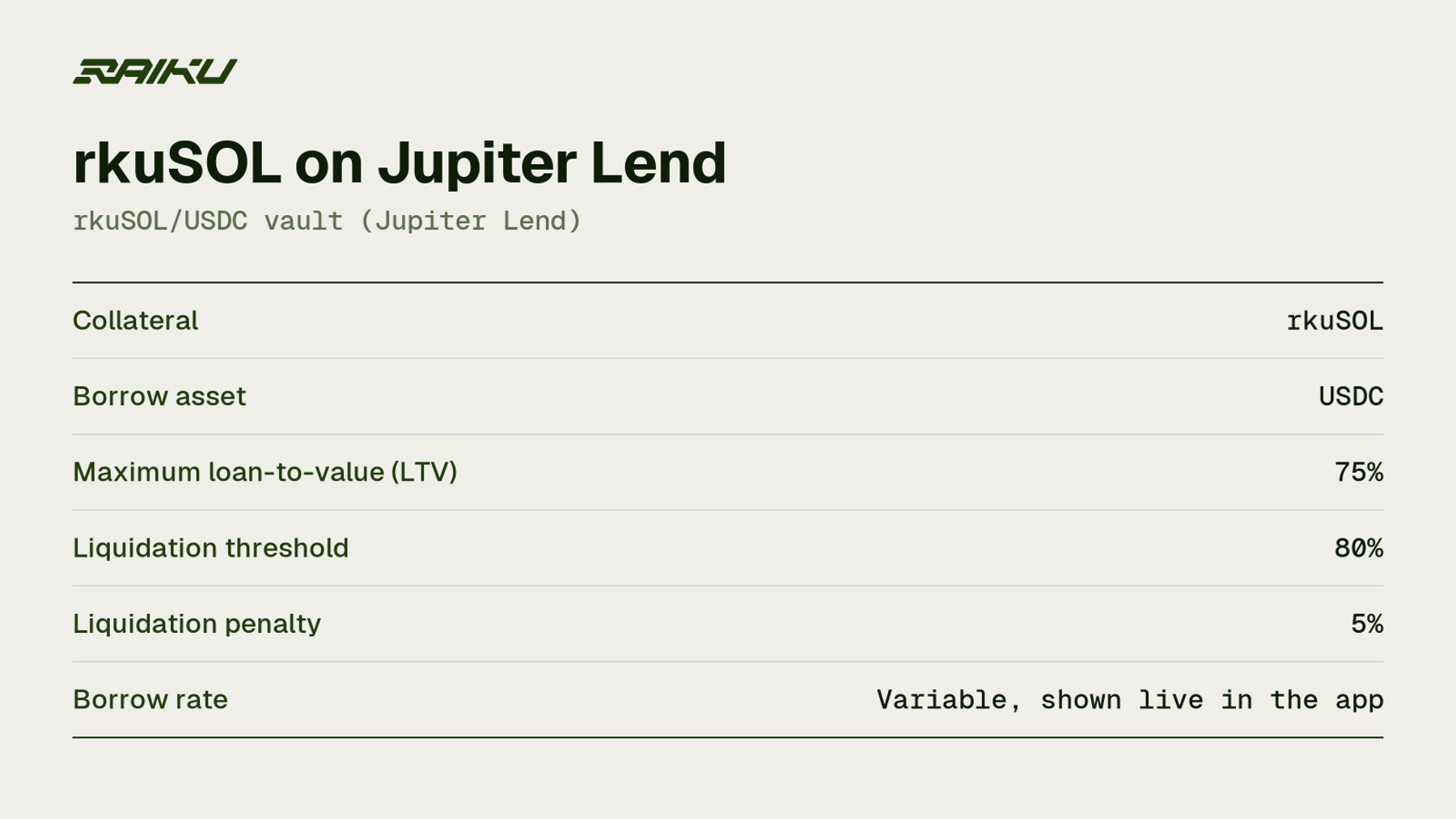
What the numbers mean. Say you deposit rkuSOL worth $2,000. You could borrow up to $1,500 of USDC (75%). If you borrowed the full $1,500, the position would become eligible for liquidation once your collateral's value fell to $1,875, because $1,500 is 80% of $1,875. That's a drop of about 6%. Borrowing less than the maximum leaves a wider margin. The 5% liquidation penalty applies only to the collateral that is actually sold in a liquidation, not to your whole position.
What are the risks?
- Liquidation. Once a position reaches the 80% liquidation threshold, third-party liquidators can repay part of the debt and take part of your collateral, plus a 5% penalty on the portion they liquidate. Jupiter's liquidations are partial, but further falls can trigger more of them. Jupiter also defines a Liquidation Max Limit: above that ratio, the position is fully liquidated. The figure for this vault isn't shown on the market page; see Jupiter's liquidation documentation.
- Borrow-side liquidity and rate spikes. USDC available to borrow is capped by Jupiter's borrow limits (base, current and max, which expand over time via Fluid's liquidity layer). When demand for USDC is high and most of the available supply is already borrowed, borrow rates can rise sharply, sometimes several times higher than normal, and the amount of USDC you can borrow or withdraw may be limited until conditions ease. A higher rate makes your debt grow faster, so check the live rate before and while you borrow.
- Price moves in SOL. Your debt is in USDC and your collateral is priced in US dollars, so a fall in the SOL price can push the position toward liquidation even if rkuSOL itself works as intended.
- Variable borrow rates. The USDC borrow rate changes with demand. A higher rate grows your debt faster.
- Oracle risk. Position health is calculated from oracle prices. Delayed or inaccurate price data could affect when liquidations happen.
- Smart contract risk. rkuSOL depends on the stake pool and Sanctum infrastructure, and Jupiter Lend runs on its own smart contracts on Fluid's liquidity layer. Bugs, outages or exploits in either could cause losses. Audits don't remove this risk.
- Depeg and liquidity risk. rkuSOL's market price can trade away from the value of the SOL backing it, especially in stressed markets. Slashing or other penalties could also reduce that backing.
- Staking rewards vary. Rewards depend on validator performance and network conditions and may change.
Read the full Raiku Risk Disclosure before using rkuSOL.
Who can't use rkuSOL?
Under Section 4 of our Terms of Use, Restricted Persons must not access or use rkuSOL Materials, including this post and stake.raiku.com. Restricted Persons include anyone resident or located in the United Kingdom, China, Japan, South Korea, Syria or a comprehensively sanctioned jurisdiction (such as North Korea, Iran, Cuba, Crimea, Donetsk or Luhansk), and anyone subject to sanctions. Section 4 sets out the full definition. Jupiter Lend applies its own terms and regional restrictions, which you should also check.
FAQ
Can I borrow against rkuSOL on Jupiter Lend? Yes. The rkuSOL/USDC vault lets you deposit rkuSOL as collateral and borrow USDC, up to a 75% loan-to-value ratio.
Does rkuSOL keep accruing staking rewards while it's collateral? Your collateral stays as rkuSOL, so it continues to accrue staking rewards through the stake pool. Rewards vary and aren't fixed.
What happens if the price of SOL falls? Your collateral is worth less, so your debt-to-collateral ratio rises. At 80%, part of the position can be liquidated, with a 5% penalty on the collateral actually sold.
What can I borrow against rkuSOL on Jupiter Lend? USDC. That's the only borrow asset in this vault.
Is Jupiter Lend non-custodial? Jupiter describes Jupiter Lend as a non-custodial lending protocol. Positions are managed by smart contracts, not held by Raiku.
Can I use rkuSOL on Jupiter Lend from the UK? No. The UK is a Restricted Jurisdiction under Section 4 of our Terms of Use, so anyone resident, located or ordinarily resident there must not access or use rkuSOL Materials, including this post. The same applies to the other Restricted Jurisdictions listed above.
Is Raiku responsible for the Jupiter Lend market? No. Jupiter Lend is an independent third party service that Raiku does not control. Jupiter runs Jupiter Lend and sets the market's parameters. Leigon Ltd (Raiku) issues rkuSOL.